New anesthesia rule gives boost to dental hygienists

July 17, 2025 ― DENTON ― Sabrina Vaughan had a big week. On an early Monday in June, the recent Texas Woman’s graduate stood in line in Austin for seven and half hours with hundreds of other dental hygiene graduates to receive her temporary license at a licensing expo.
On Tuesday, she returned to work at a private dental office in Saginaw for her first official day as a hygienist. Throughout the week, she performed cleanings, deep cleanings, took X-rays and provided patient education.
“It has been a very exciting week,” Vaughan said. “I have loved it so much. This is what I have wanted to do for such a long time.”
After Vaughan received her temporary license, she submitted paperwork to obtain a local infiltration anesthesia certificate. Vaughan is part of the first cohort of dental hygiene graduates at TWU and in the entire state of Texas that had the opportunity to become certified in local infiltration anesthesia.
In May 2024, the Texas State Board of Dental Examiners (TSBDE) adopted the local infiltration anesthesia rule. The new rule lists the procedures and requirements for dentists in Texas to delegate the administration of local infiltration anesthetic to dental hygienists holding a TSBDE-issued certificate.
This ruling has been highly anticipated in Texas for many years. Dental hygienists began administering local anesthesia in the 1970s, but Texas was one of two holdout states.
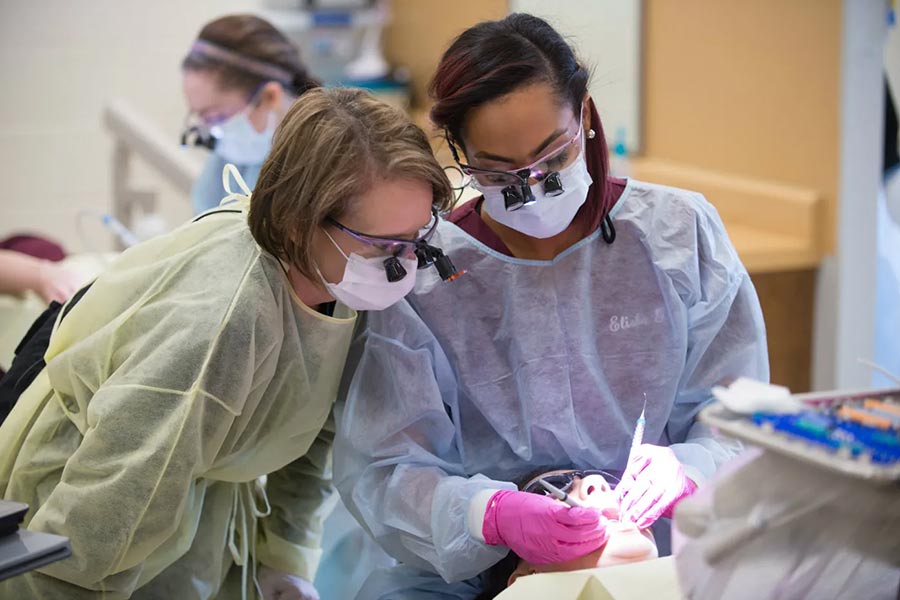
The new rule limits dental hygienists in Texas to local infiltration only, which is defined as injecting a local anesthetic near the nerve endings of the teeth and supporting oral tissues. Infiltration is limited to the tissue of the tooth, while local anesthesia or a block injection numbs the nerve.
TWU’s dental hygiene program director Charlene Dickinson sees this as a step forward.
“We are very proud and excited,” Dickinson said. “We are excited to be able to be teaching it because it does advance the scope of dental hygiene practice in a positive direction.”
Hygienists are primarily working with tissue when they do cleanings. If a patient has sensitivity to the tissue, a local infiltration anesthetic can be administered to ensure patients receive care without pain.
One of the benefits of hygienists administering local anesthesia is less waiting time for patients.
“It will definitely be more efficient,” Vaughan said. “I think it will be more comfortable for the patient as well. Simply because there is a shorter wait time and so it allows less time for anxiety to build. And also it prevents us from running overtime or taking up more of the patient’s time if we have to wait on the doctor to get through a few patients.”
Local anesthesia is not new to dental hygiene students. At TWU, learning about local anesthesia was always in the program, just not the certification process. Students practiced on mannequins. They just couldn’t practice on each other.
The ruling was made too late to be incorporated in the Texas Woman’s curriculum for the 2024-25 school year so Dickinson and her staff offered the certificate course to the graduating seniors, including Vaughan, after May 2025 finals.
Going forward, Dickinson and her team have created a pain management course, which would satisfy the majority of the didactic requirements for the certification.
“The students will be able to provide local anesthesia to patients in the clinic in their senior year to be able to fulfill the requirements that the Texas State Board has that is five live patient experiences,” Dickinson said.
At the TWU Dental Clinic, junior and senior dental hygiene students receive hands-on training with patients. Starting in the fall of 2025, senior students will be able to administer local infiltration anesthesia under the direct supervision of the dentist. Dickinson and her staff will also offer local anestheia infiltration courses for practicing, licensed dental hygienists twice a semester.
Vaughan recognizes this as a big moment for her field.
“This has been amazing for the profession and I hope that this advancement continues,” Vaughan said. “Not only does it help us, who it really helps is the patients and that’s our No. 1 priority.”
Media Contact
Amy Ruggini
Digital Content Manager
940-898-3628
aruggini@twu.edu
Page last updated 4:41 PM, September 18, 2025