Movement is key learning thread to PT, OT, dance students
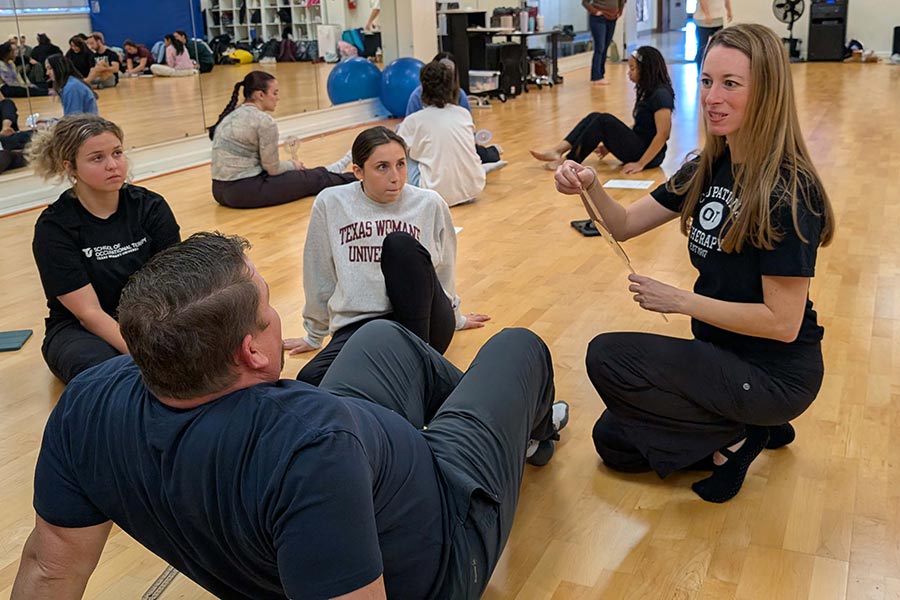
Nov. 20, 2025 ― DENTON ― Physical therapy and occupational therapy students frequently partner at interprofessional education (IPE) events at Texas Woman’s. Since IPE occurs when students from two or more different health professions learn together, these pairings make sense.
So, it was a little out of the norm to have dance students involved in two IPE events with first-year PT and OT students in November. Turns out that movement is the common thread that connects the three disciplines.
“I think that as therapy professors, we're always looking to movement as the common feature in our learning,” said Kaelee Brockway, an assistant professor in the School of Physical Therapy. “And when we try to bring different groups of students together to learn about movement, obviously dance was a very natural group of people to think about bringing in.”
Brockway, Megan Price, an assistant clinical professor in the School of Occupational Therapy, and Sarah Gamblin, a professor of Dance, developed the Denton campus IPE events for their students to learn about hip, knee and ankle movement.
And, while PT, OT and dance are different disciplines, the first-year students are all currently learning similar concepts in the classroom.
The PT students are taking an anatomy class as well as a lifespan development course, where they learn about the physical and cognitive development of early and middle adulthood. OT students are in a musculoskeletal course, and the dance students are taking an experiential anatomy for dancers class.
Students separated into small groups and rotated through three stations with each stop focusing on one of the three disciplines.
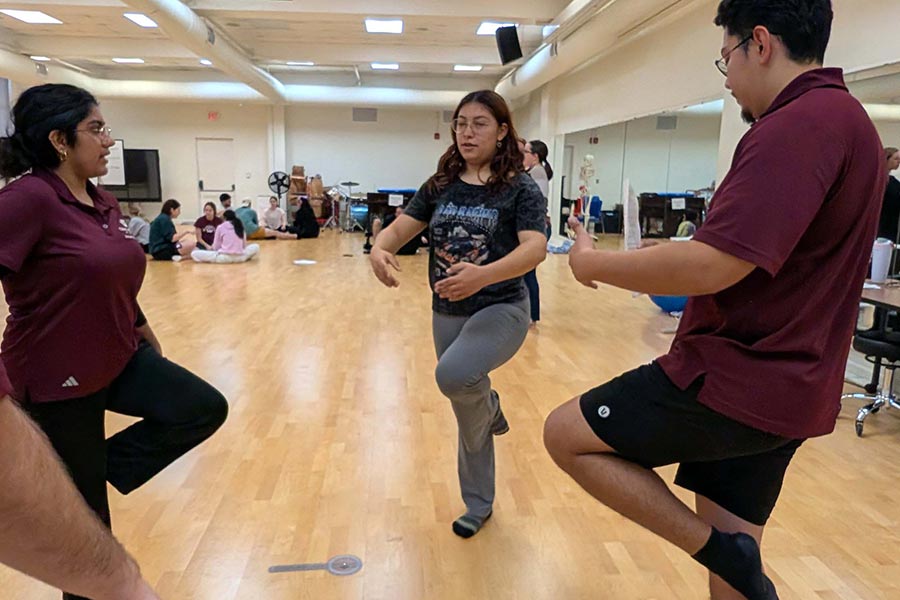
At the physical therapy station, PT students acted as anatomy experts. They pointed out the various muscles of the lower extremities and what they felt like at rest versus when they are moving. The dancers demonstrated various movements to showcase how they use these muscles.
“And because our dancers are the experts in movement, we're getting to feel them at a very high level of function that our students aren't going to feel in the clinic,” Brockway said.
At the OT station, students used a goniometer to measure the foot’s range of motion. A goniometer is an instrument used for the precise measurement of angles.
“They were manually ranging what an ankle feels like, and then using the goniometer to measure what our dancers have in range of motion compared to themselves,” Price said. “So they could see a difference in a dancer's joint mechanics versus their own.”
Gamblin thought it was interesting for her dancers to learn the concrete concepts beneath all of the movement and art that they are making.
“I think it's been really informative for the students and really energizing for them,” Gamblin said.
The three professors are contemplating new sessions in the spring that would be more dynamic, involving movement analysis and biomechanics.
Some eager students aren’t waiting, and have talked about getting together before then.
“We just like to hear about what they're learning and what we're learning and putting it all together,” said OT student Savannah Adams.
The sessions opened OT student Teresa Ustanik’s eyes to using dance as therapy.
“The things that they're doing as preventive measures as dancers and with their stretches and flexibility are also things that could be used in an OT situation to help out,” Ustanik said.
For many of the students, it was the first time they were able to learn outside the classroom and incorporate this level of movement.
“Although they have this singular expertise at the moment, they can put their expertise together with the expertise of so many others to have a greater effect as a whole than their individual parts,” Brockway said.
Media Contact
Amy Ruggini
Digital Content Manager
940-898-3628
aruggini@twu.edu
Page last updated 9:57 AM, November 20, 2025