Soon, why your protein shake is about to taste better
March 18, 2026 — DENTON — If you haven’t noticed an uptick in protein-enriched products these days, you might be living in a cave.
Indeed, protein is quite the trend these days. And companies are responding to the craze. It’s not just in shakes, either. There’s protein-enriched pasta. Protein-added tortilla chips. Starbucks has a line of protein-boosted beverages. There’s even protein-packed Pop-Tarts.
How do all these products taste?
Two professors at Texas Woman’s are currently working on research to help make protein-related products taste great.
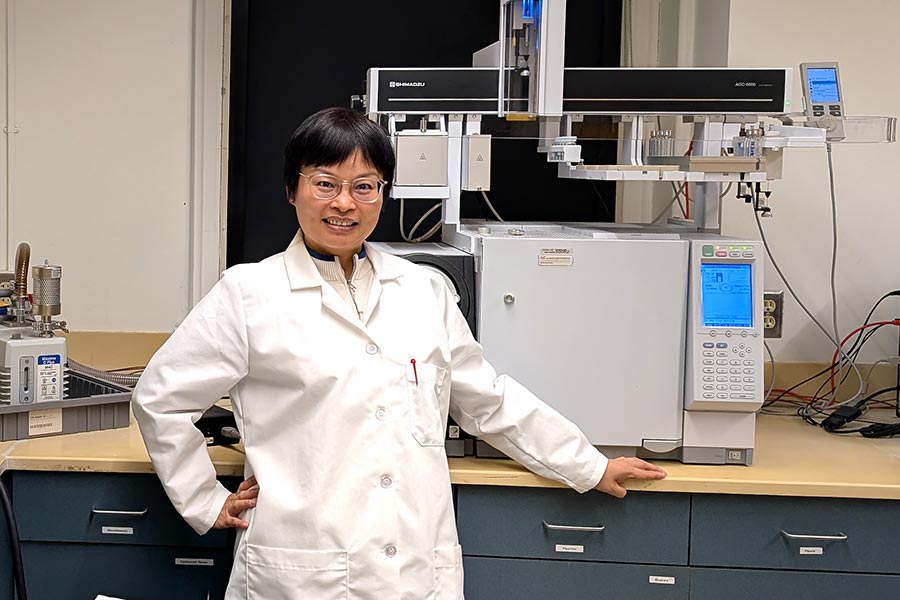
Xiaofen Du, PhD, a flavor associate professor in the nutrition and food sciences department, and Shiru Lin, a chemistry assistant professor in the chemistry department, received a grant from BUILD Dairy to improve the flavor of whey protein products by studying how proteins interact with flavor compounds.
Du, Lin and their graduate students are hoping their findings will lead to better tasting and more consistent flavors in high-protein foods and drinks, helping companies develop products that not only taste good but last longer and meet consumer preferences at a lower cost.
While you may say that strawberry-flavored protein shake tastes pretty good, do you know why?
The professors were curious to find out the mechanisms of whey protein and how it interacts with different flavors. There’s little research that details what exactly happens when flavor is added to whey protein.
“Ultimately, our goal is to create a guide on how to create a beneficial flavor for whey protein,” Du said.
Du is excited about the research for a few reasons. After studying flavor in fruits and vegetables for the past decade, this study is her first project involving dairy. She is also intrigued about the novel approach of using computational chemistry in their research. This type of modeling uses computer simulations to help solve chemical problems.
If Du just used her lab and typical traditional flavor analysis tools, this research project would take several years. By joining forces with Lin, they can use computational chemistry to cut down on labor and time.
“Because Dr. Lin has those tools, we are able to simulate whey protein molecules and flavor molecules and how they interact with each other,” said Du. “And then we are going to use the traditional approach to verify the interaction. That will speed up our research.”
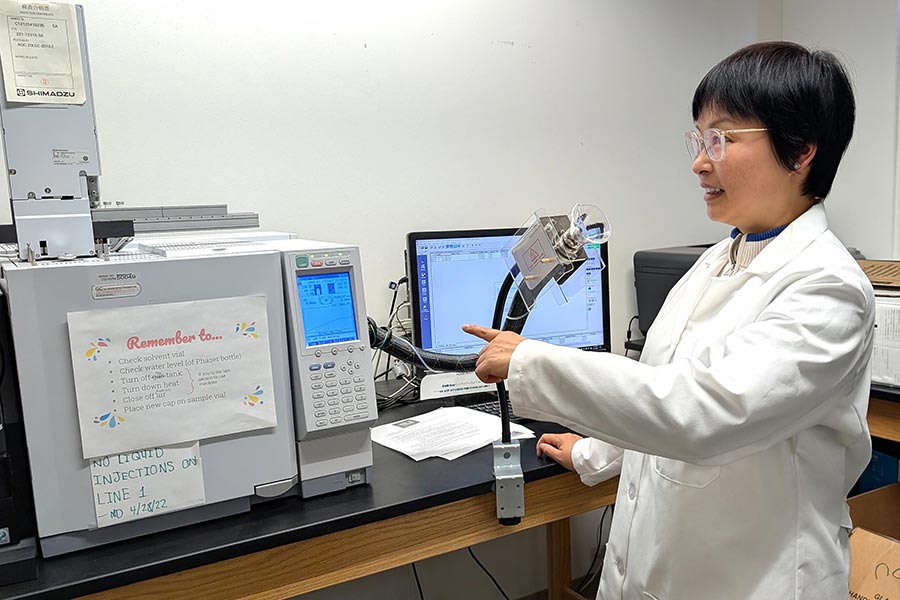
The traditional approach uses instruments such as gas chromatographs and mass spectrometers. These instruments help identify flavor molecules binding to protein in a test sample.
In this project, Du and her team will examine the molecules that make up flavors and proteins. Each different flavor that we are familiar with, like vanilla, can be made up of 70 or 80 different molecules.
By using computational chemistry, Lin can work with a large amount of molecules.
“By doing computational chemistry along with traditional flavor analysis, we are able to create a much better, sustainable flavor for whey protein,” Du said.
Little has been published on this topic using computational chemistry. In March, Du and her team published their first review article on their project in the Journal of Dairy Science.
Not only would this resulting flavor taste good, Du and Lin’s research would show how to create this flavor at a lower cost by taking out any unnecessary chemicals. Consumers don’t just want protein products that taste good, there is also a demand for clean labels and ingredient transparency.
Their two-year study will include developing a methodology, testing it with a small sample of molecules and then applying it to a hundred different molecules before beginning the traditional flavor analysis with a narrowed down list of molecules. Based on the results, they will be able to pick a representative flavor.
Their research is sponsored by Glanbia Nutritionals, a major supplier of whey proteins.
Du is also working on other studies that involve dairy, including probiotic yogurt funded by Daisy Brand (Principal Investigator, Du; Co-Principal Investigator, Wang) and dietary fiber of exopolysaccharides (Principal Investigator, Wang; Co-Principal Investigator, Du).
Media Contact
Amy Ruggini
Digital Content Manager
940-898-3628
aruggini@twu.edu
Page last updated 1:01 PM, March 18, 2026