Researcher aims to make food safer
Oct. 13, 2026 — DENTON — Listeria is a wily and dangerous food pathogen. Found naturally in soil and water, the bacteria can survive chilled temperatures and cause life-threatening conditions. It is the fourth-leading cause of death from foodborne illness, according to the Centers for Disease Control and Prevention.
Developing quick methods to detect listeria is essential to keeping contaminated foods off the grocery shelves. A Texas Woman’s researcher is working on a unique method that could potentially detect listeria in the air within a few hours.
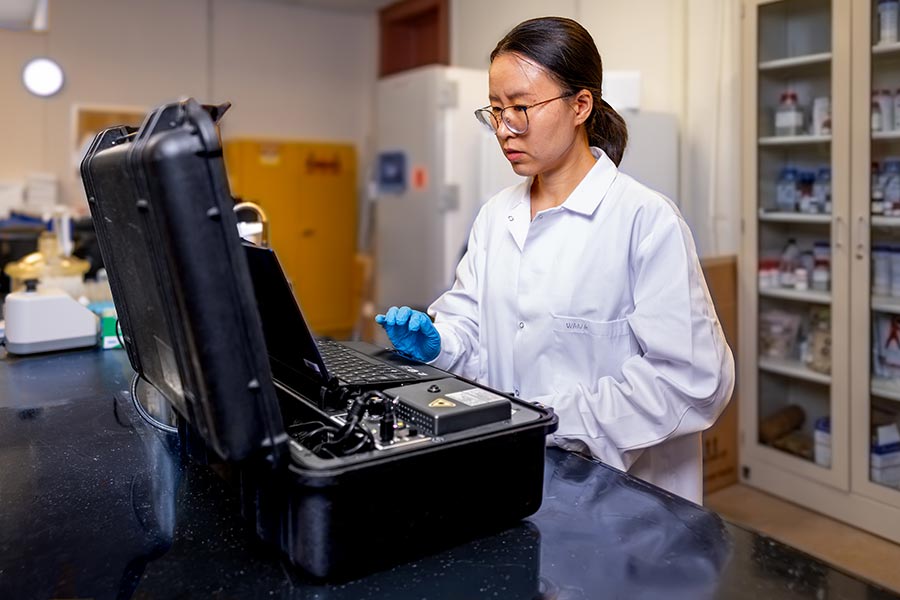
Danhui Wang, an assistant professor in the nutrition and food sciences department, received a $292,000 grant from the U.S. Department of Agriculture to develop a filter-assisted method for rapid detection of aerosolized listeria using Raman spectroscopy.
“We want to develop that rapid method to be able to detect those airborne listeria that already exist in food manufacturing,” Wang said. “In this way, we can do early intervention on that because we do not want listeria to exist in the food manufacturing and then get on the food product.”
Listeria can spread easily in ready-to-eat foods, such as deli meats and soft cheeses, because they are often refrigerated for long periods and don’t require further heating.
The bacteria also transmits through the air. High-pressure washing in manufacturing plants can aerosolize listeria, allowing it to float through the air and resettle on food.
Most traditional monitoring relies on swabbing surfaces or testing food directly, but those methods can take several days. Several rapid detection methods, such as Raman spectroscopy, have been developed for a faster response.
Raman spectroscopy is a technique that provides a structural fingerprint to identify chemical compounds. It involves illuminating a sample with a laser and analyzing the light that is scattered off the surface of the substance. That scattered light can be used to identify chemical components.
Wang has dedicated her academic career to food safety, including the last four years at Texas Woman's. She has broad experience with the Raman spectroscopy, using it during postdoctoral research with pesticides and publishing several peer-reviewed articles on the technology in the last five years.
This USDA grant marks the largest award of her career and she is excited about the challenge.
“I think for any project there will be some challenging part and that's also why we will do this,” Wang said. “If it's not challenging, then it will be the same as other projects.”
The uniqueness of the project and the challenge is the direct sampling of the air rather than swabbing the food or the surfaces for pathogens.
The process for the two-year project will include building the chamber in Wang’s lab, optimizing parameters to generate the aerosolized bacteria and collecting samples onto filters for analysis with the Raman spectroscopy.
After developing a method, Wang and her team will compare it with the more traditional processes. To ensure safety, Wang will use a nonpathogenic bacteria commonly used in research to mimic the pathogenic listeria.
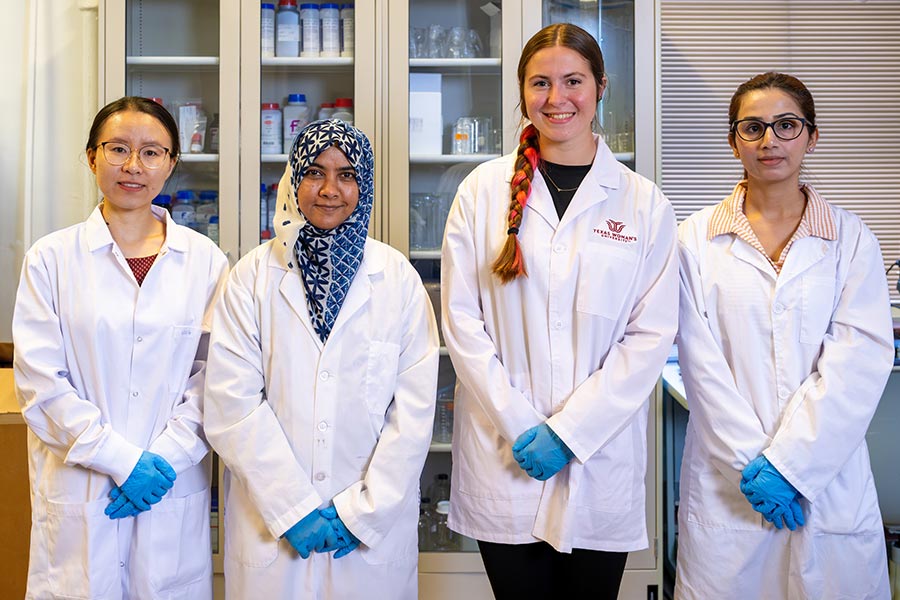
Two PhD students and an undergraduate student will assist Wang with the project as well as two colleagues from other institutions.
“Later, if we work out this method, then maybe in the future we can also detect other viruses that exist in the air,” Wang said.
Media Contact
Amy Ruggini
Digital Content Manager
940-898-3628
aruggini@twu.edu
Page last updated 9:53 AM, October 14, 2026